
How Many Solar Panels Does Your Business Need?
The number of solar panels depends on an optimal peak power calculated by a sizing study, not on your roof surface. The decisive role of self-consumption and storage.
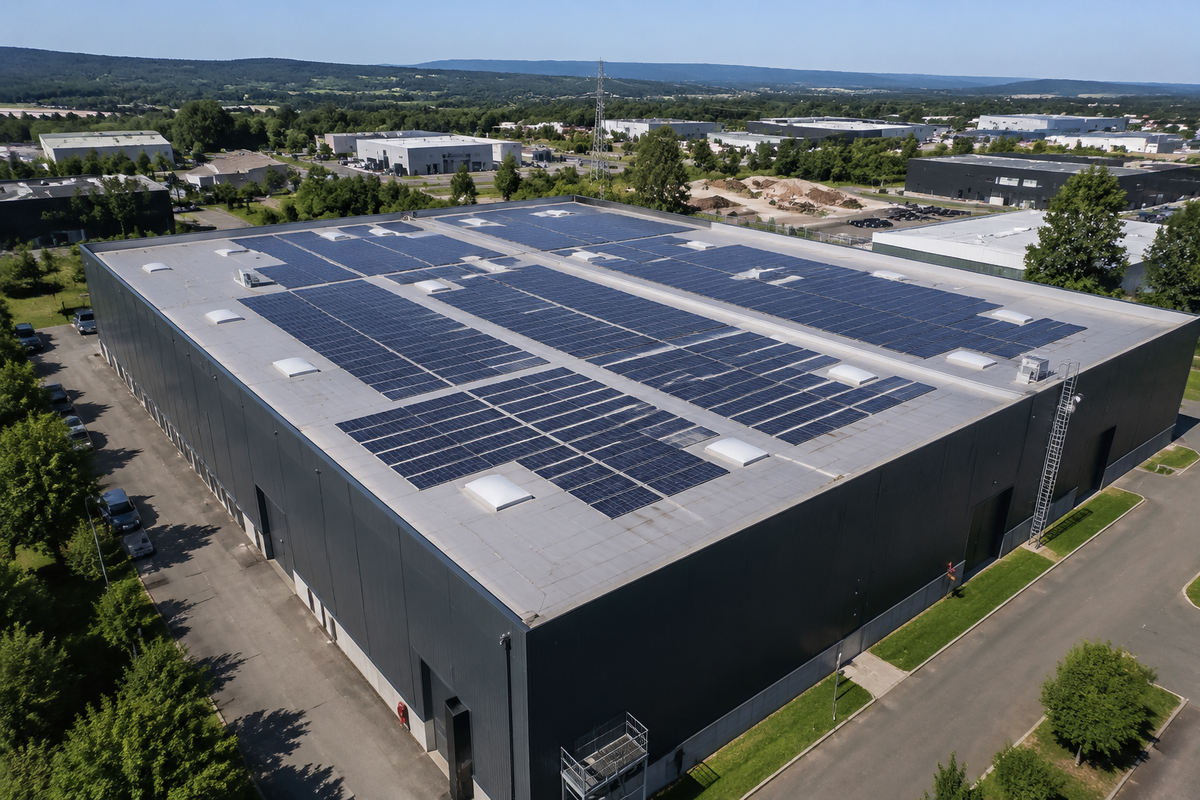
Working out the number of solar panels your business needs doesn't start with measuring your roof. There's an optimal theoretical size for the installation, and that's precisely what a sizing study is for. The site's physical constraints — roof area, orientation, available space — only come into play afterward, to adjust that starting point.
This article explains why the right calculation is worked out in peak power (kWp) before being translated into a number of panels, and why pairing a battery with the system often changes the answer.
Why has PV sizing become essential for businesses?
PV sizing is the calculation that determines how much power to install to maximize a project's profitability, based on the site's actual consumption and its solar exposure. A few years ago, this step could be skipped: the government guaranteed unconditional, attractive feed-in tariffs. The logic was simple — worst case, you sold the surplus back to the grid.
That reasoning no longer holds. Since the S21 tariff order of June 1, 2026, the buyback rate for surplus electricity from installations of 100 kWp or less has been set at €0.011/kWh before tax, far below previous levels (arrêté S21, Journal officiel of June 4, 2026). The self-consumption bonus has also been scrapped for installations between 9 and 100 kWp.
The consequence is direct: adding panels on the assumption that surplus can be resold no longer makes economic sense. By comparison, a self-consumed kWh avoids buying electricity from the grid, which in 2026 costs a low-voltage SME between €180 and €250/MWh all-in (Acieb Énergie, 2026 data). Against the €11/MWh paid for surplus resale, self-consumption is clearly the more attractive option.
Should sizing be based on roof area or on consumption?
On consumption. Available roof area sets a physical ceiling, but it says nothing about the economically optimal size. Installing as many panels as the roof can hold frequently leads to overproduction during hours when the site consumes little — meaning electricity gets fed into the grid at a rate that today is worth very little.
The right starting point is the site's load curve: what hours the business consumes power, how much, and how that consumption overlaps with expected solar output. It's this overlap that determines the self-consumption rate, and therefore profitability.
Why factor in the battery from the sizing study onward?
Because a PV + battery system often leads to a different solar installation than PV alone. The battery stores the surplus produced during the day so it can be used when the site is consuming, which mechanically raises the self-consumption rate.
In practice, sizing solar and storage together frequently makes it possible to choose a smaller system — and therefore a lower upfront investment — while achieving higher self-consumption. The optimal number of panels for a PV + battery project is therefore not the same as for a PV-only project.
At Battwoo, two types of studies are carried out: sizing a battery to match an existing solar installation, and a full PV + battery study for a new project. In both cases, the goal is the same: match peak power and storage capacity to actual consumption, not to a surface-area constraint.
What is self-consumption, and why maximize it?
Self-consumption refers to the share of electricity produced that is consumed directly on site, rather than sold back to the grid. It's maximized because every self-consumed kWh avoids buying electricity at market price, which is far higher than the surplus buyback rate. The battery is precisely the tool that shifts consumption of the solar surplus over time.
What data is needed to start a sizing study?
Three pieces of information are enough for a proper study. They make it possible to reconstruct the overlap between solar output and consumption, hour by hour.
- Hourly consumption data, provided by Enedis. It describes the site's actual load curve. Battwoo will tell you how to obtain it.
- The location, ideally precise geolocation, in order to simulate the installation's solar exposure at 10-minute intervals and estimate the expected annual output.
- Electricity purchase rates from your energy supplier.
From these three inputs, the simulation calculates the peak power that optimizes return on investment, taking into account the consumption profile and the local solar resource.
So, how many solar panels does your business need?
The study first provides a suggested peak power, expressed in kWp (kilowatt-peak, the installation's nominal power under standard conditions). The number of panels then follows from that: it depends on the power rating of the module chosen.
In practice, you first need to choose a panel model. A 455 Wp module and a 500 Wp module won't give the same count for the same target power. Once the model is set, the exact number of panels follows directly from the target peak power.
- Target peak power: from the study, in kWp.
- Panel unit power: depends on the manufacturer, in Wp.
- Number of panels: target peak power divided by the module's unit power.
Ahead of the study, an indicative range can be given to you. It should never be taken at face value: only the full study guarantees the quantity of panels genuinely suited to your site and to competitive returns on investment.
Frequently asked questions
How many solar panels does a business need?
There's no standard number. The count depends on the optimal peak power calculated by the sizing study, and then on the unit power of the panel model chosen. Two businesses with the same roof area can have very different needs depending on their consumption curve.
Should the installation be sized based on available roof area?
No. Roof area sets a physical ceiling, but the optimal size depends on the site's consumption and local solar exposure. An installation sized purely on available area risks overproducing during off-peak hours and feeding the grid electricity that today is poorly compensated.
Does a battery change the number of panels needed?
Yes. A PV + battery project often ends up with a smaller system than a PV-only project, while delivering a better self-consumption rate. Storage shifts the daytime surplus to consumption hours, which changes the optimal peak power.
What data needs to be provided for a sizing study?
Two things are enough: the site's hourly consumption data, available via Enedis, and the project's precise location to simulate solar exposure. These inputs make it possible to overlay production and consumption hour by hour.
Why is selling surplus back no longer profitable?
Since the S21 tariff order of June 1, 2026, the buyback rate for surplus from installations of 100 kWp or less is €0.011/kWh before tax (arrêté S21, Journal officiel of June 4, 2026). This rate, far below what a business pays to buy electricity, makes self-consumption clearly more advantageous than resale.
What is an installation's peak power (kWp)?
Peak power, expressed in kilowatt-peak (kWp), is the nominal power the installation produces under standard sunlight conditions. It's the reference figure for sizing: the number of panels is then derived from the target peak power and the unit power of the modules chosen.