





Skip to content
Battwoo

Solution

Custom stationary storage, affordable and sustainable, engineered to maximise your gains.

Concrete benefits for businesses that have or plan a solar installation: maximised self-consumption, peak power smoothing, time-of-use shifting, backup, participation in grid-flexibility mechanisms, and spot-market arbitrage.

Warranty
5,000 cycles
Useful life
15–30 years
Typical ROI
4–7 years
Carbon footprint
÷ 4 vs new

Trusted by

  • European Union
  • Bpifrance
  • Réseau Entreprendre Paris
  • CNAM
  • VDE Laboratory

Optimisation levers

Six economic optimisation levers for stationary storage

Each lever stacks with the others and can be activated simultaneously by our control software. The sizing and the mix are defined during the personalised study, based on your consumption and generation profile.

01 Solar · Photovoltaic

Maximise your solar self-consumption

Valorise up to 90 % of your PV production.

Without storage, sites typically consume only 40 % of their solar generation. With a Battwoo BESS, surplus energy is stored and released later — evenings, nights, weekends. You maximise your PV investment and gain independence from your retailer.

  • Compatible with new and existing solar installations
  • Real-time monitoring and control of generation and consumption
  • Greater independence from your retailer and from tariff hikes
Solar self-consumption with stationary storage — production vs. consumption breakdown over 24hThe orange curve shows photovoltaic production (a bell centred on noon). The dark curve shows site consumption, oscillating with a morning and an evening peak. Three areas stand out: direct self-consumption below the lower of the two curves during the day, surplus stored or injected when production exceeds consumption, and battery restitution late in the day when solar drops to zero and the battery supplies the evening load.0h4h8h12h16h20h24hDirect solar self-consumptionSurplus(battery charging)Restitution(self-cons. via battery)Solar productionSite consumption
Maximise your solar self-consumption — graphic illustration
02 TURPE · EVCI · Industry

Smooth power peaks (peak shaving)

Lower your subscribed power and the TURPE on your bill.

A stationary storage unit absorbs your site's power peaks, allowing you to reduce your subscribed power — and therefore the TURPE (the French regulated tariff for public electricity networks) on your bill. Particularly relevant on sites with EV charging infrastructure (EVCI).

  • Especially effective on sites with EVCI or intermittent industrial processes
  • Lower subscribed power, eliminating overshoot penalties
  • Continuous automated monitoring and control — no human intervention
Peak power shaving with stationary storageThe battery absorbs draw peaks above the subscribed power (here 150 kW), avoiding overshoots and reducing the TURPE — especially effective for sites with EV charging infrastructure (EVCI).Drawn power (kW)0h4h8h12h16h20h24hCap 150 kW200 kW peakDraw without batteryDraw shaved by BESSEnergy absorbed
Smooth power peaks (peak shaving) — graphic illustration
03 Time-of-use tariff

Off-peak / peak time-of-use shifting

Capture the spread between off-peak and peak hours.

If your site is on a time-of-use tariff, the Battwoo BESS charges from the grid during off-peak hours (low rate) and discharges during peak hours (high rate). The tariff spread becomes a recurring source of savings, optimised daily by the control algorithm.

  • Compatible with French time-of-use contracts (Bleu, Vert, Tempo, EJP)
  • Control algorithm that exploits off-peak / peak windows
  • Recurring savings from commissioning, with no contract change
Time-of-use shifting between peak and off-peak hoursThe battery charges from the grid during off-peak hours (low tariff) and discharges during peak hours (high tariff), leveraging the time-of-use contract.State of charge (%)0h4h8h12h16h20h24hOFF-PEAK HOURSPEAK HOURSOFF-PEAK↑ charge↓ dischargeBattery state of charge (SoC)Off-peak windows
Off-peak / peak time-of-use shifting — graphic illustration
04 Backup · Business continuity

Power-supply security and blackstart

Guaranteed continuity on your critical loads.

Protect production lines, cold rooms, servers and sensitive equipment against grid outages and micro-cuts. The Battwoo BESS detects a fault and switches over in under 20 milliseconds, supplying critical loads with no human intervention. Blackstart mode lets you restart a site fully islanded from the grid.

  • Automatic transfer in under 20 ms on grid fault
  • Protects critical loads for several hours, depending on installed capacity
  • Compatible with existing back-up generators and uninterruptible power supplies
Supply security and blackstart by BESSOn grid outage, the Battwoo BESS transfers in under 20 ms and powers critical loads (production lines, cold rooms, servers) for several hours — without human intervention.t-2sgrid outaget+30 minSwitchover< 20 msGrid voltageVoltage supplied by the Battwoo BESS230 V0 V
Power-supply security and blackstart — graphic illustration
05 aFRR · mFRR · RTE

Participate in grid flexibility markets

Generate additional passive income through grid services.

Take part in the French grid flexibility markets. Enedis and RTE remunerate storage operators that adjust consumption and generation in real time — secondary reserve (aFRR, automatic over 5 minutes) and tertiary reserve (mFRR, manual over 15 minutes). Grid balancing becomes a source of recurring passive income.

  • Access to aFRR and mFRR reserves via a certified aggregator
  • Automated control linked to RTE signals
  • Recurring passive income depending on market conditions
Participation in RTE grid services — aFRR and mFRR on the French networkThe Battwoo BESS plugs into the French high-voltage transmission grid operated by RTE. Batteries deployed at business sites participate in aFRR (automatic secondary reserve) and mFRR (manual tertiary reserve) to stabilise the grid — generating additional passive revenue.aFRRsecondary reserve · 5 minmFRRtertiary reserve · 15 minRTEgrid operator
Participate in grid flexibility markets — graphic illustration
06 EPEX · Day-ahead · Intraday

Spot-market arbitrage

Buy low, sell high.

As intermittent renewables grow, the electricity market becomes more volatile. With the Battwoo BESS, you can charge the battery when spot prices are low (EPEX day-ahead, intraday) and release the stored energy when prices spike.

  • Daily spread observed up to €600/MWh on the day-ahead market
  • Buy when prices are low, valorise when prices are high
  • Control algorithm connected to EPEX day-ahead and intraday markets
Tariff arbitrage on the EPEX day-ahead spot marketThe battery charges when electricity prices are low (at night) and discharges or resells the stored energy when prices are high (morning and evening). Observed daily spread reaches €600 per MWh on the day-ahead market.Electricity price (€/MWh)0h4h8h12h16h20h24hCHARGE (low prices)DISCHARGEDISCHARGE€€€EPEX day-ahead spot price (€/MWh)
Spot-market arbitrage — graphic illustration

Second life

A deliberate choice that dramatically cuts your carbon footprint.

By reusing electric-vehicle battery modules diagnosed and certified fit for stationary second life, the carbon footprint is divided by four versus a new battery. This approach valorises a resource that has already been produced — without compromise on quality or warranty.

  • Warranty

    5,000 cycles

    contractually warranted

  • Useful life

    15–30 years

    depending on usage profile

  • Typical ROI

    4–7 years

    by site and active levers

  • Carbon footprint

    ÷ 4 vs new

    EV modules diagnosed for stationary use

Turnkey service

A 4-step process — transparent and tightly controlled

From the initial study to operation, a single project manager runs the programme. Clear timelines, precise deliverables, contractual warranties.

  1. 01

    Technical and economic study

    Audit of your consumption profile and solar installation. Precise sizing, multi-year savings simulation, full business case.

    • Collection of site load curves and supply prices
    • Integration of existing generation assets, if any
    • Analysis of consumption and generation profile
    • Sizing of the storage unit to your requirements
    • All KPIs required to decide: IRR, payback, ROI, NPV
  2. 02

    Custom manufacturing

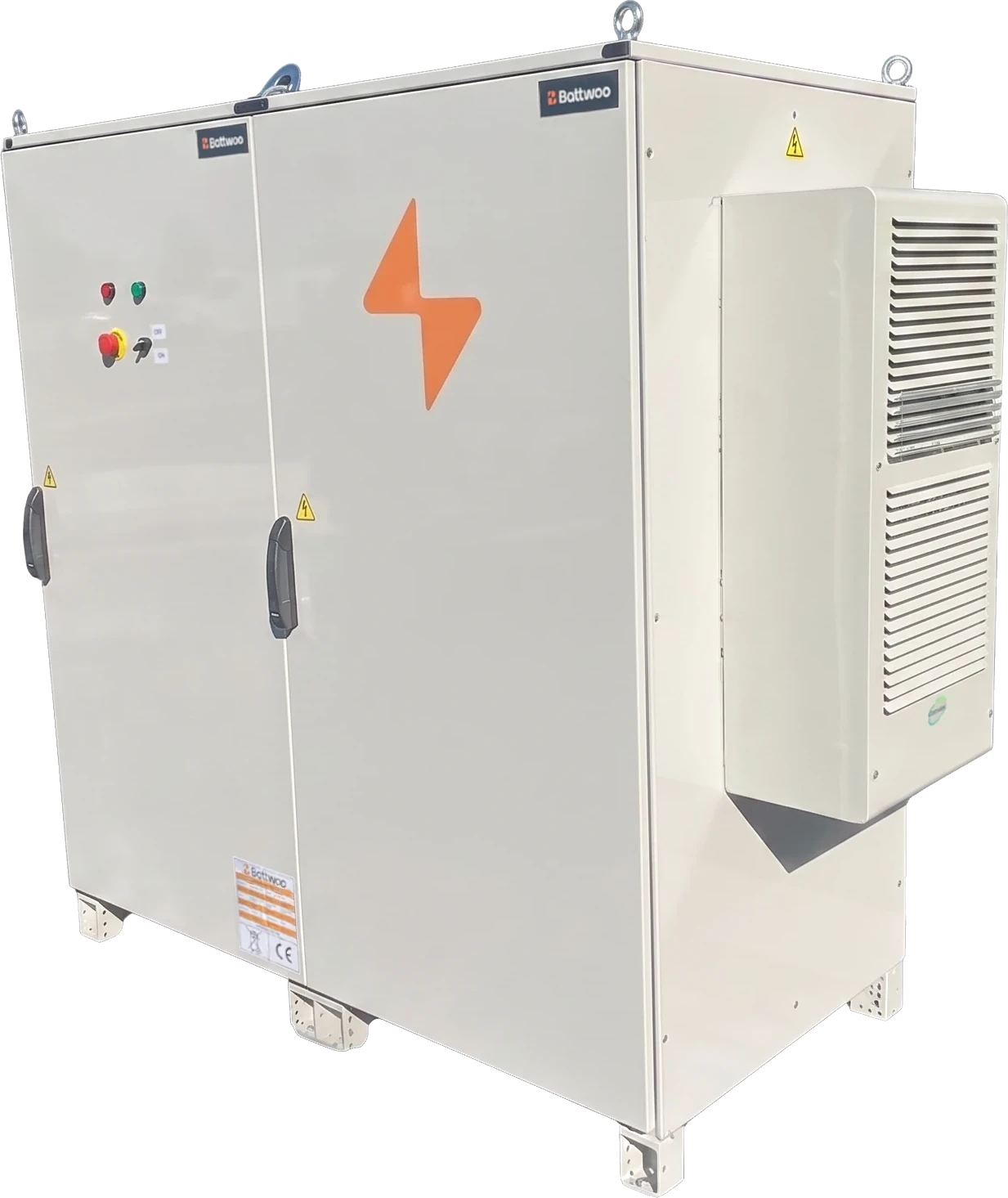
    Sourcing and diagnosing batteries from European suppliers, assembly in our Spanish workshop, full integration with switchbox, thermal management and wiring.

    • Sourcing and diagnosing batteries from European suppliers
    • Custom manufacturing in our Spanish workshop
    • Configuration and programming of the BMS (Battery Management System)
    • Integration in the cabinet or container: switchbox, heating, HVAC, back-up load, wiring
    • Factory Acceptance Test (FAT) before shipping
  3. 03

    Installation and commissioning

    Turnkey delivery, full connection to existing systems (grid, PV, inverter), Consuel compliance, and start-up for production operations.

    • Cabinet or container delivered turnkey on site
    • Connections to other systems (grid, PV, inverter)
    • Site Acceptance Test (SAT): internal connections, anchoring, post-shipment integrity, e-stops
    • Consuel compliance and start-up for production operations
  4. 04

    Operation and maintenance

    24/7 supervision, precise control and continuous optimisation of the control software. Annual preventive and reactive maintenance included.

    • Real-time monitoring: status, output, state of charge
    • Live changes to control rules at customer request
    • Remote shutdown and restart
    • Annual preventive maintenance: charge/discharge of each module, voltage balancing, SoH check

Frequently asked questions

Everything you need to know.

BESS, peak shaving, aFRR / mFRR, spot arbitrage, 5,000-cycle warranty — answers to the questions every business asks when looking at stationary storage.

  • A BESS is a battery energy storage system that captures electricity (from solar or the grid) and releases it at the most valuable moment. For a business, it maximises self-consumption, reduces subscribed power via peak shaving, and generates revenue on the energy markets.

  • The TURPE (the French regulated tariff for public electricity networks) is partly driven by your subscribed power. Peak shaving uses the battery to absorb the site's consumption peaks. By smoothing those peaks, you can lower the subscribed power and remove overshoot penalties, durably reducing your bill.

  • RTE remunerates owners of storage solutions that make their capacity available to stabilise grid frequency. aFRR (automatic Frequency Restoration Reserve, secondary reserve) and mFRR (manual Frequency Restoration Reserve, tertiary reserve) are flexibility mechanisms that generate complementary passive income. The valorisation depends on volumes offered and on the clearing prices set by RTE's reserve markets.

  • Off-peak/peak shifting exploits fixed tariffs (night vs. day). Spot-market arbitrage on EPEX day-ahead is more dynamic: you charge the battery when prices are low (e.g. strong wind or solar generation on the grid) and discharge when prices spike.

  • Yes — our BESS units include a backup function with Blackstart mode. On grid fault, the system transfers in under 20 milliseconds to supply your critical loads (servers, cold rooms, industrial processes). Blackstart mode can also restart a fully islanded site with no human intervention.

  • An undersized system will not cover your needs; an oversized one weighs on profitability. We analyse your 10-minute load curves to design the unit that maximises cumulative gains across the six optimisation levers. Across our projects we observe a typical ROI between 4 and 7 years — every site is a specific case, this is not a contractual guarantee.

Interested?

Personalised technical and economic study in under 7 days.

Custom battery sizing to maximise gains based on your consumption profile. Free and no-obligation.

Start my study

Reply within 48 business hours — Confidential